Date: 2026
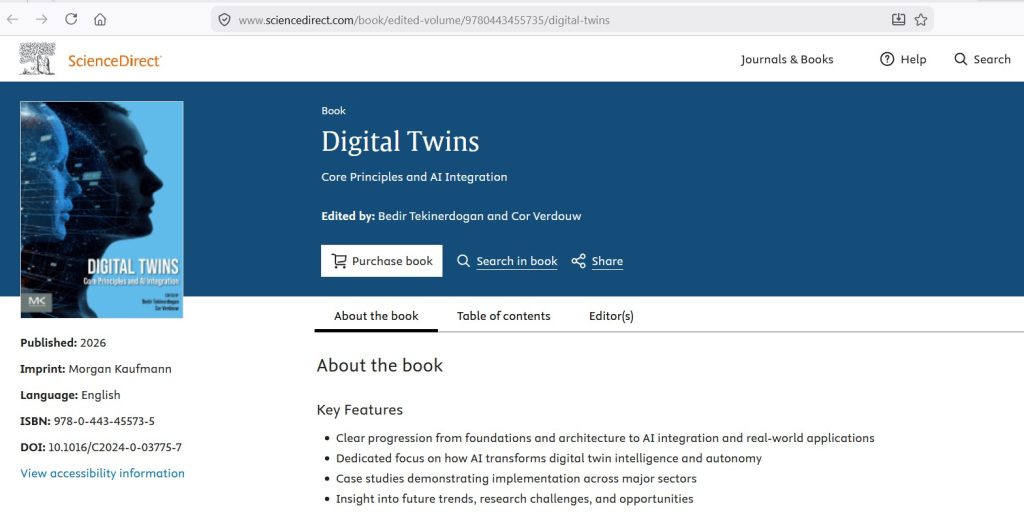
Two research chapters related to the application of digital twin technologies in disaster and emergency management have been published in the Elsevier book Digital Twins.
The first chapter, “Reducing Errors in Disaster Management Data with Digital Twin Architecture” (Chapter 19), presents a digital twin architecture designed to improve the quality, consistency, and reliability of disaster management data. The proposed approach addresses common challenges associated with data collection, integration, and processing, helping decision-makers reduce errors and enhance situational awareness during emergency response operations.
The second chapter, “Digital Twins for Disaster Management: Mitigating Structural Obstacles in the Response Pipeline” (Chapter 20), examines how digital twin technologies can help identify and overcome structural bottlenecks in disaster response workflows. The chapter demonstrates how digital twins can support more efficient coordination, adaptive response planning, and improved operational resilience across complex disaster management systems.
Together, these publications contribute to the advancement of digital transformation in disaster and emergency management by demonstrating the potential of digital twin technologies to improve decision support, operational efficiency, and data quality. The presented research closely aligns with the objectives of the Erasmus+ KA220 project SUDEM – Sustainable Disaster and Emergency Management Processes Digitalisation, supporting the integration of innovative digital technologies into education, research, and professional practice.
The chapters were authored by Yusuf Kaşan, Mehmet Akşit, Seher Turan, and Togay Yazar, and were published in the Elsevier book Digital Twins.