Date: 29 April 2026
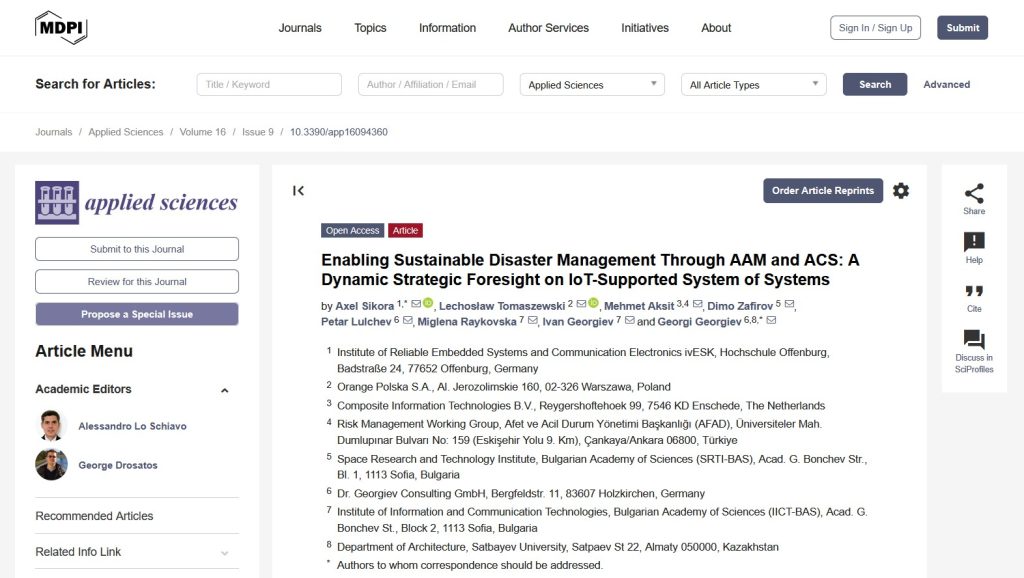
A new scientific article entitled “Enabling Sustainable Disaster Management Through AAM and ACS: A Dynamic Strategic Foresight on IoT-Supported System of Systems” has been published in the MDPI journal Applied Sciences as part of the Special Issue Novel Technologies and Applications for Internet of Things.
The publication presents a strategic foresight study exploring how Advanced Air Mobility (AAM), Advanced Communication Systems (ACS), and the Internet of Things (IoT) can be integrated into a comprehensive System of Systems (SoS) to support sustainable and resilient disaster management.
The research identifies key technological enablers for next-generation disaster management, including resilient 5G/6G communication networks, unmanned aerial systems (UAS), interoperable data fusion, digital twins, and intelligent decision-support systems. The study also analyses current challenges, such as fragmented standards, limited interoperability between organisations, and the need for more resilient communication infrastructures during emergency operations.
Importantly, the paper builds upon the experience and results of several international research initiatives, including the Erasmus+ KA220 project SUDEM – Sustainable Disaster and Emergency Management Processes Digitalisation, together with the REGUAS, 5G!Drones, and ETHER projects. The findings contribute to the development of future educational programmes, digital disaster management strategies, and policy recommendations supporting the digital transformation of emergency management.
The publication also proposes a strategic roadmap for the future development of digital disaster management, highlighting the importance of harmonised communication standards, integrated data exchange, modular system architectures, and capacity building through higher education and lifelong learning.
The article was authored by Axel Sikora, Lechosław Tomaszewski, Mehmet Akşit, Dimo Zafirov, Petar Lulchev, Miglena Raykovska, Ivan Georgiev, and Georgi Georgiev, representing leading academic and research institutions from Germany, Poland, the Netherlands, Türkiye, Bulgaria, and Kazakhstan.
The publication demonstrates the growing scientific impact of the SUDEM project and its contribution to advancing research on the digitalisation of disaster and emergency management through interdisciplinary collaboration and innovative technologies.